Ingredients 8 Chicken drumsticks 1/2 Cup and 2 table spoons olive oil 1 White onion, diced 1 Table spoon minced garlic 2 Cups short-grain ‘Calaspara’ rice 2 Pinches of saffron (‘azafrán’ in Spanish) 2 1/2 Cups clam juice 2 1/3 Cups chicken stock Salt and freshly ground black pepper 1/2 Cup diced red bell pepper (‘pimiento rojo’ in Spanish) 1/2 Cup green peas 1 Tablespoon of ground cumin (‘comino’ in Spanish) 1 Tablespoon of ground cinnamon (‘canela molida’ in Spanish) 1 Diced red tomato 1/2 Diced cucumber 8 Clams (‘almejas’ in Spanish) 8 Black mussels (‘mejillones’ in Spanish) 8 Large shrimp, peeled 12 Small scallops (‘vieiras’ or ‘peregrinas’ in Spanish) 1 Slices chorizo (This paella normally uses dry chorizo, but feel free to use the chorizo of your choice)
1. Paella Valenciana – The original paella was born in Valencia. Besides rice, this includes chicken and pork. Many natives include rabbit, but many restaurants do not include it because they know that many tourists are not familiar with rabbit. 2. Paella Mixta – This paella is a mixture of the paella Valenciana and the paella de marisco. It contains both meat, chicken and seafood. Sometimes this paella is called Paella Andaluz and is the most commonly ordered and eaten paella, specially by tourists.
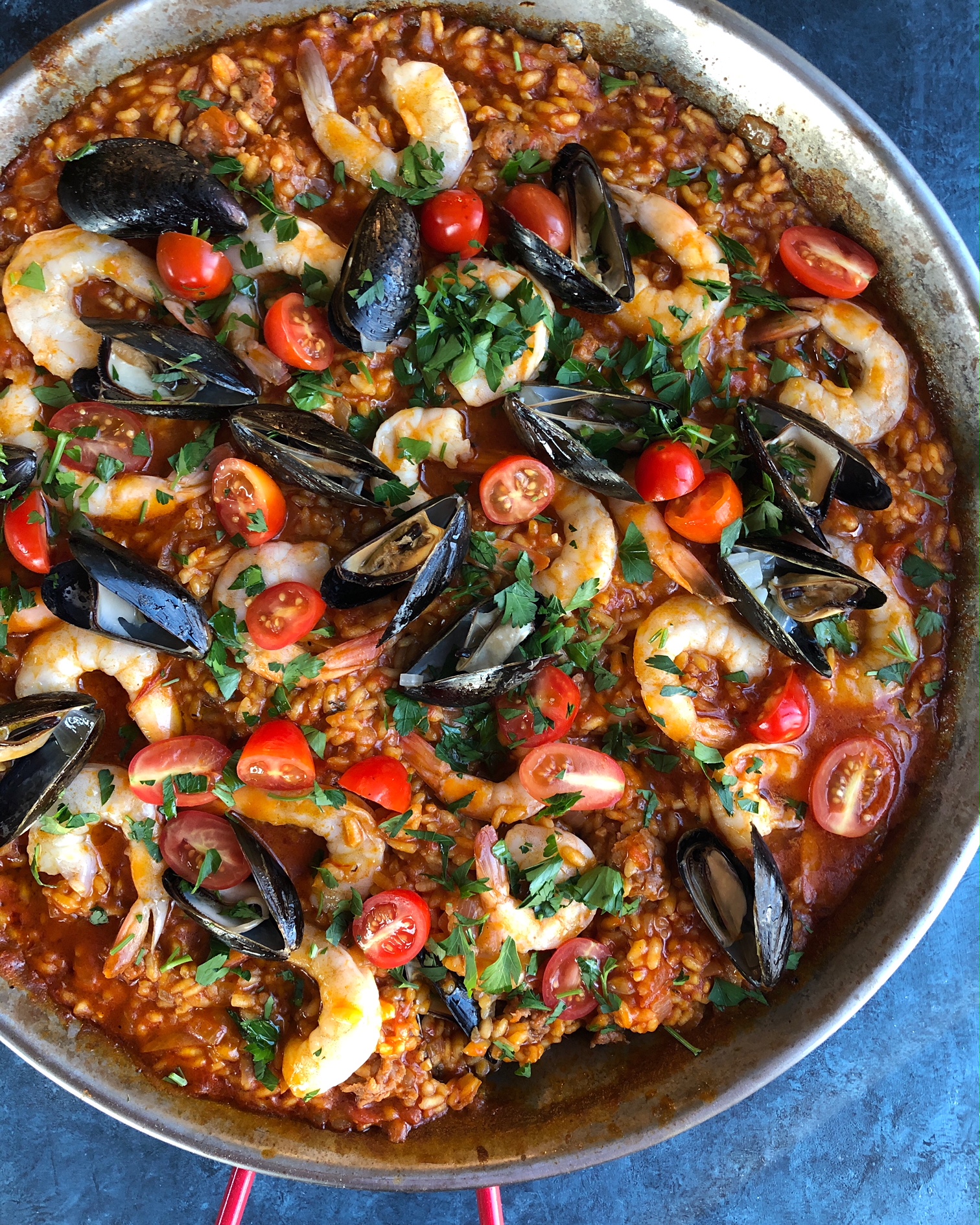
3. Paella de Marisco (known as Paella Marinera when it has 5 seafood ingredients) – This is a seafood paella that does not contain meat. It usually contains prawns, mussels, calamares, clams, and other seafood. This type of paella is sometimes more ‘soupy’ and often goes by the name ‘Arroz Caldoso’ (which translates to ‘soupy rice’) in restaurants. The juices of the seafood add liquid to the Paella. This said, it add more intensity and flavor, a personal favorite. 4. Paella Vegetariana – This paella contains a variety of vegetables like artichokes, lima beans, red and green peppers, and rice and does not include any meat or seafood. As the name well says, it’s a vegetarian paella. 5. Paella Negra – This paella is cooked with squid ink and is, therefore, black in colour. It has a peculiar taste that natives love, so if you’re feeling adventurous, go for it!
It’s a little confusing but ’paella’ or to be more exact ‘la paella’ is the name for cooking pan itself and not the dish. The word comes from old Valencian (in Valencia they have their own language somewhat similar to Catalan) and probably has its roots in the Latin ‘patella’ meaning pan.
There are however, some other wonderful (if less likely) theories about the origins of the name. The most romantic of them suggests that the dish was first prepared by a lover for his fiancée and that the word is a corruption of ‘para ella’ (meaning ‘for her’ in Spanish). Like all myths there is a small grain of truth in this and although many women still traditionally do the cooking in Spain, making paella is usually left to the men – very much like BBQ’s in the UK!!!
It has also been suggested that the word ‘paella’, is derived from the Arabic word “Baqiyah”, which means ‘leftovers’ – once again emphasizing both the dish’s humble and arabic beginnings.
Paella – the most sociable of all culinary occasions
In Spain paella is still unique. Not only do families congregate on mass to eat paella in restaurants, but it is often cooked at weekends at holiday homes in ‘bodegas’ or ‘txokos’ (large dining areas where families gather) or at beach or mountain picnic sites. There are many paella competitions all over Spain and very often a giant paella is the centrepiece for many fiestas.
It’s easy to see why – paella can create a party, a ceremony and a debate (often over the making of the paella itself!!) – making it one of the most sociable and enjoyable of all culinary occasions.
And finally, if you don’t already know – and you want to impress your friends, “paella” is pronounced “pa-e-ya” with the “e” as in “bet”.
Paella is one of the most popular and famous of global dishes, to define exactly what paella contains is almost impossible. There are as many variations of paella as there are cooks, with many claiming that their recipe is the best tasting or most authentic. The origins of the dish, however, are quite humble. Understanding a little of its history will help explain why so many varieties exist.
Valencia in Eastern Spain is the undisputed home of paella. It is one of the largest natural ports in the Mediterranean and has been one of the most important rice-producing areas in Spain since rice was introduced by the Moors over 1200 years ago. In fact, the Spanish word for rice is ‘arroz’, which is derived from Arabic, not Latin like most of Castilian Spanish.
Humble Beginnings
Paella was originally farmers’ and farm labourers’ food, cooked by the workers over a wood fire for the lunchtime meal. It was made with rice, plus whatever was to hand around the rice fields and countryside: tomatoes, onions and snails, with a few beans added for flavour and texture. Rabbit or duck might also have been added, and for special occasions, chicken plus a touch of saffron for an extra special colour and flavour. Paella was also traditionally eaten straight from the pan in which it was cooked with each person using his own wooden spoon.
Little by little, as ‘Valencian rice’ became more widely available, paella recipes were adapted with new variations appearing. With Valencia being on the coast, it is no surprise that various types of seafood crept into the recipes over the generations. Now paella is the generic name of 200 or so distinctive rice dishes or ‘arroces’ from the Valencia region let alone other parts of Spain and the rest of the world. To this day a “true” Paella Valenciana has no seafood but a mixture of chicken, rabbit and snails with green and white beans.
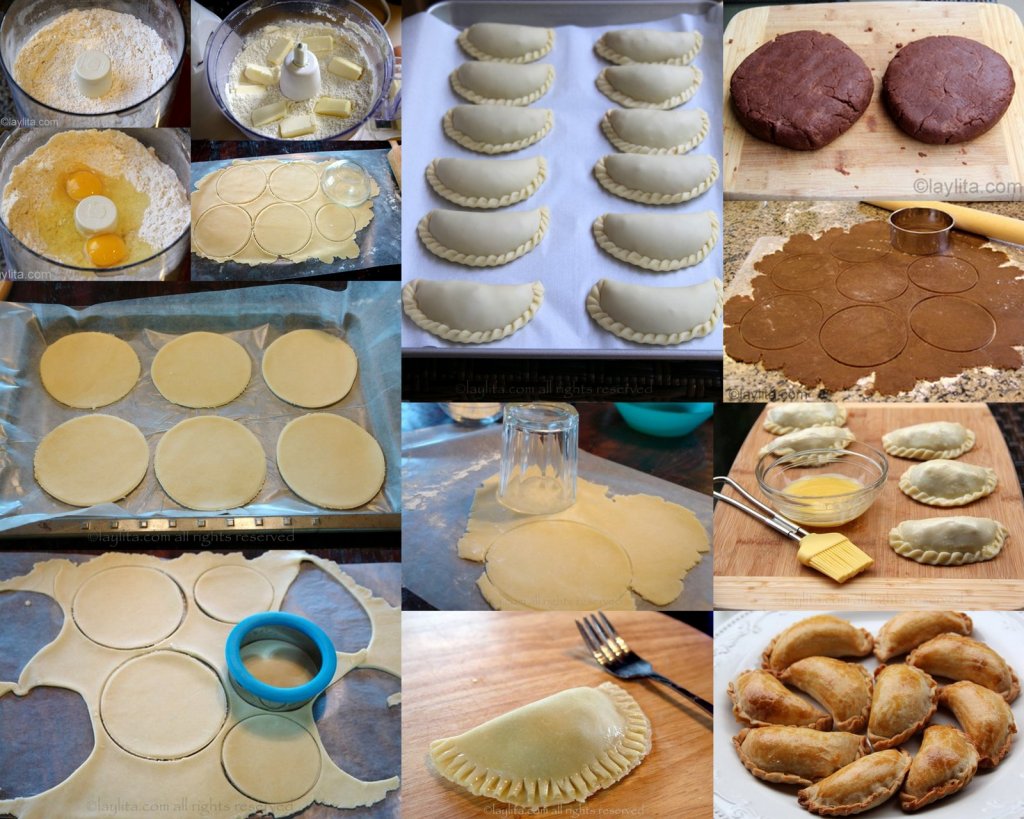
Mix the flour, sugar and salt in a food processor.
Add the butter, eggs and water until a clumpy dough forms.
Knead the dough for a few minutes.
Form dough into 2 balls, flatten into thick discs, and chill in the refrigerator for at least 30 minutes.
Roll out the dough into a thin sheet and cut out round disc shapes for empanadas, use round molds or a small plate or cup as a mold, you can choose how large based on whether you want small or medium sized empanadas .
Use the empanada discs immediately or store in the refrigerator or freezer to use later.
Assembling and baking sweet empanadas:
To assemble these sweet empanadas or dessert turnovers, place the filling of your choice on the center of each empanada disc. Don’t add too much filling since it makes it harder to close or seal the empanadas when they’re overstuffed.
To seal the empanadas, fold the disc and seal the edges by pressing the dough with your fingers. If needed, you can brush the inside edges with egg white, it will act as a glue for the empanadas. You can do a final seal by pressing the top of a fork against the edges. You can also try a curl type seal, called repulgue or churito, by using your fingers to twist the curl the edges – this is harder with sweet empanadas than with regular savory empanada dough.
For best results, refrigerate the empanadas for at least 30 minutes before baking – this also helps them seal better and prevents the filling from leaking out.
If you want your empanadas to have a nice golden finish, then you can brush them with egg wash (a whole egg whisked or egg yolk plus a few drops of water whisked). After brushing the empanadas with egg wash, you can sprinkle sugar (I prefer brown sugar or demerara) on top. You can also sprinkle them with regular or powdered sugar after baking.
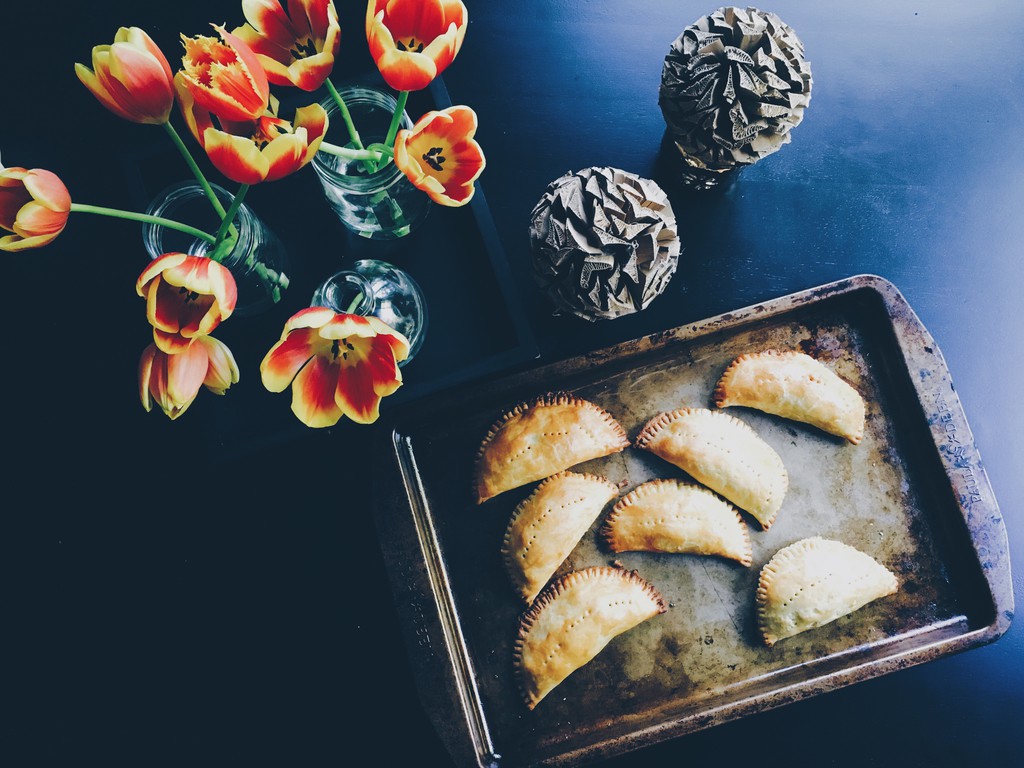
Bake the empanadas in a pre-heated oven. I usually bake them at 375F/190C. The baking time will vary based on the oven and size of empanadas, and should be in the range of 18-25 minutes – the empanadas will be ready once they are golden on top.
The Spanish word for bread is “pan”. “Empanar” is a verb form that means “to bread”. Emapanada is the past-participle, “breaded”.
It’s basically a single-serving turnover. It can be filled with sweet foods like fruits, sugars, and syrups, or savory foods like meats, cheeses, and oils.
They originated in northwest Spain, in a region known as Galicia.
Today they are most popular in Spanish-speaking countries across Europe and South America.
Originally they were made with bread dough, but now they are made with pastries as well.
Argentine empanadas are often served during parties and festivals as a starter or main course. Shops specialize in freshly made empanadas, with many flavors and fillings.
During Lent and Easter, empanadas de Cuaresma fillings with fish (usually dogfish or tuna) are popular.
Belize
In Belize, empanadas are known as panades. They are made with masa (corn dough) and typically stuffed with fish, chicken, or beans. They are usually deep fried and served with a cabbage or salsa topping. Panades are frequently sold as street food.
Cape Verde
Cape Verde cuisine features the pastel, as well. Cape Verdean pastéis are often filled with spicy tuna fish. One particular variety, the pastel com o diabo dentro (literally: Pastel with the devil within), is particularly spicy, and is made with a dough made from sweet potatoes and cornmeal.
Philippines
Filipino empanadas usually contain ground beef, pork or chicken, potatoes, chopped onions, and raisins (somewhat similar to the Cuban picadillo) in a somewhat sweet, wheat flour bread. There are two kinds available: the baked sort and the flaky fried type. To lower costs, potatoes are often added as an extender, while another filling is kutsay, or garlic chives (kutsay in Cebuano and Tagalog; 韭菜 kú-chhài in Lan-nang).
Empanadas in the northern part of the Ilocos are different. These usually have savoury fillings of green papaya, mung beans, and sometimes chopped Ilocano sausage (chorizo) or longaniza and egg yolk. There have also been people who make empanada filled with mashed eggplant and cabbage, which they call poqui poqui.
Sicily (Italy)
The ‘Mpanatigghi are stuffed, consisting of halfmoon-shaped panzarotti filled with a mixture of almonds, walnuts, chocolate, sugar, cinnamon, cloves and minced beef. These are typical of Modica, in the province of Ragusa, Sicily. They are also known as impanatiglie or dolce di carne (pasty of meat).
They were probably introduced by the Spaniards during their rule in Sicily which took place in the sixteenth century; this is suggested from the etymology of the name which comes from the Spanish “empanadas or empanadillas” (empanada), as well as from the somewhat unusual combination of meat and chocolate, which occurs several times in the Spanish cuisine. In past centuries for the preparation of ‘mpanatigghi game meat was used but today beef is used.
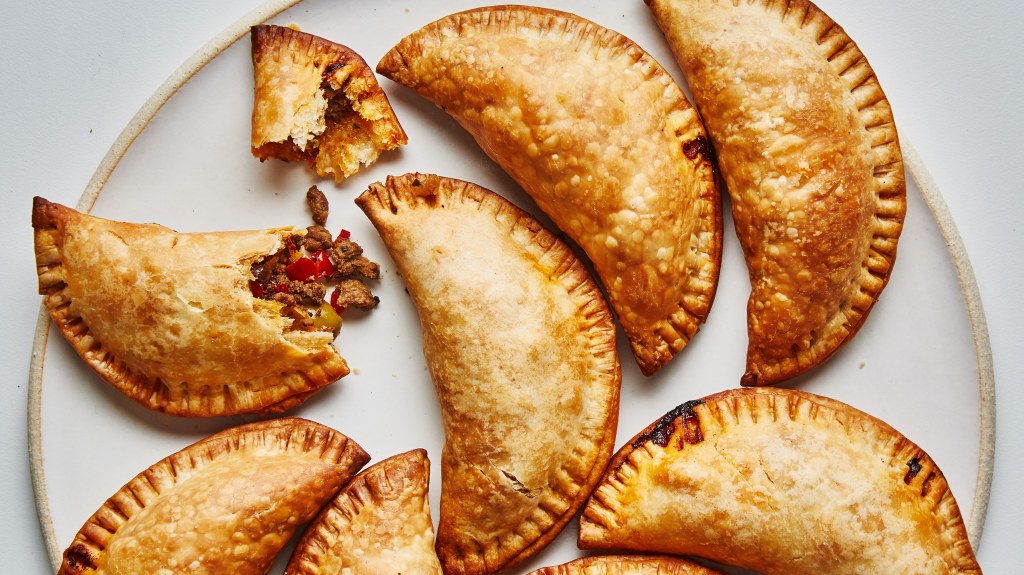
Empanadas are similar to cut-up pies and they’re typically filled with cod fish or chicken. An empanada is made by folding a disc of thinly rolled dough over the filling into a semicircle, then crimping the edges to seal it. The dough is often made with wheat flour, but this isn’t universal. Corn flour or cornmeal can be used as well, and some countries’ traditions call for a plantain or potato base. The exact content of the dough can depend on whether the empanadas will be baked or fried.
It’s said that the art of making a perfect empanada is to hold the dough, spread open, in one hand, while using the other hand to fill it and to crimp the edges. Tradition aside, you can now purchase empanada machines at many appliance stores to make the process much easier.
It’s considered acceptable to eat empanadas at any meal, including breakfast, but they’re usually enjoyed at lunch or as a snack. They can make a full meal on their own and no one will leave the table hungry.
The empanadas we enjoy today are thought to have originated in Galicia, Spain. The idea of wrapping a hardy filling in pastry dough may well have stemmed from the Moors who occupied Spain for hundreds of years. A cookbook published in Catalan, Spain in 1520 includes empanadas made with seafood.
The first empanadas in Western Hemisphere are credited to Argentina. The U.S. has even given the empanada a dedicated holiday — National Empanada Day, celebrated on April 8.
Empanadas are a traditional Christmas treat in New Mexico. They’re commonly referred to as creoles in the southwest and the south, and as fried pies in the southeast.
Empanadas Across the Caribbean Cubans fill their empanadas with seasoned ground beef or chicken before frying them. They’re prepared and eaten the same way in the Dominican Republic and Puerto Rico.
An empanada is a stuffed bread or pastry baked or fried in many countries of Latin America and the south of Europe. The name comes from the verb empanar, meaning to wrap or coat in bread. Empanada is made by folding a dough or bread patty around the stuffing. The stuffing can consist of a variety of meats, vegetables, or even fruits.
Empanadas have their origins in Galicia (Spain) and Portugal. They first appeared in Medieval Iberia during the time of the Moorish invasions. A cookbook published in Catalan in 1520 mentions empanadas filled with seafood among its recipes of Catalan, Italian, French, and Arabian food. It is believed that empanadas and the very similar calzones are both derived from the Arabic meat-filled pies, samosas.
In Galicia and Portugal, an empanada is prepared similarly to a large pie which is cut in pieces, making it a portable and hearty meal for working people. The filling of a Galician and Portuguese empanada usually includes tuna, sardines or chorizo, but can contain codfish or pork loin. The meat or fish is commonly in a tomato, garlic and onion sauce inside the bread or pastry casing. Due to the large number of Galician immigrants in Latin America, the empanada gallega has also become popular in that region.
The dish was carried to Latin America and the Philippines by Spanish colonists, where they remain very popular to this day.


_caseras.JPG)

.jpg)


 Spanish food